 Siwei Luo
No Gelation and Global Existence for a Boltzmann Equation with Regularly Varying Mass-Exchange Rates
Abstract
We develop a no-gelation mechanism that yields global solutions to the spatially homogeneous Boltzmann equation with mass exchange for Grad-cutoff hard potentials \(B=E^\gamma b(\xi), 0<\gamma<1\) and regularly varying mass-exchange rates. Without assuming any higher mass moment, we construct a convex superlinear weight assembled from dyadic hinges. Production of the weighted moment by collisions between large particles of comparable mass is absorbed by dissipation through collisions with a uniformly populated reservoir of bounded-mass particles. Regular variation makes the signed increments in these two collision configurations comparable, while mass conservation and \(\gamma<1\) yield the vanishing factor \(L^{\gamma-1}\). This yields a uniform moment bound of the mass-cutoff approximations on every finite time interval and rules out finite-time mass escape to infinity. Consequently, for every nonnegative initial density with finite physical moments, we obtain a global integral weak solution.
Introduction
Size redistribution driven by mass transfer via aggregation or collision is observed in systems such as branched polymerization, aerosol and colloid dynamics, and droplet collisions [Flo41, Fri00, AP90]. A central question in the resulting size-structured kinetic equations is whether repeated interactions can transport a positive part of the total mass across an unbounded sequence of size scales within a finite time. This phenomenon is called gelation in coagulation theory. Mathematically, it appears as a loss of the first mass moment carried by the finite-size distribution [Ald99, Ley03, BLL19]. The gelation process does not contradict the exact conservation of mass in each elementary interaction, because local conservation laws alone cannot control the total mass flux moving toward \(m=\infty\). Therefore, ruling out gelation requires a quantitative mechanism capable of both controlling this transfer toward large masses and ensuring the conservation of the first moment at every finite time. Finding such a mechanism for the Boltzmann equation with mass exchange, under physically natural exchange rates that may grow up to the linear scale, is the main purpose of this paper.
The standard example of this issue is the Smoluchowski coagulation equation. In this process, each binary event merges two clusters into a single cluster with a mass equal to the sum of the two, thereby generating a one-way flux toward larger sizes. The growth of the coagulation kernel determines whether this flux is compatible with the conservation of the first moment: for a broad class of homogeneous kernels of degree greater than \(1\), finite-time gelation occurs, whereas appropriate subcritical growth conditions can yield mass-conserving solutions [EMP02, ELMP03, BLL19]. In coagulation–fragmentation systems, fragmentation introduces a competing flux toward smaller sizes, and its strength relative to coagulation can lead either to global mass conservation or to persistent gelation [EMP02, ELMP03, LvR15]. Exchange-driven growth is also related to the present problem, in which each interaction transfers mass between two clusters and can move mass in either direction. Nevertheless, sufficiently rapid exchange can still drive mass to infinity. Recent results identify regimes of ordinary growth, finite-time gelation, and instantaneous gelation [BNK03, SG25].
The Boltzmann equation with mass exchange (BME), introduced by Degond and Liu in a discrete-mass setting [DL25] and later studied directly for continuous masses in [LL26], places this redistribution mechanism in a coupled mass–velocity phase space. An incoming pair \((m,v)\), \((m_1,v_1)\), with total mass \(S=m+m_1\), is replaced by two outgoing particles with masses \(\alpha S\) and \((1-\alpha)S\), while the post-collisional velocities are chosen so that total mass, momentum, and kinetic energy are conserved in every collision. The event has the \(2\to2\) structure and therefore also preserves particle number. At the opposite boundary \(m=0\), fragmentation processes may exhibit shattering, in which a positive amount of mass is transferred to particles of vanishing size in finite time. For the continuous-mass BME, we ruled out this phenomenon in [LL26, Proposition 4.2 and Lemma 8.5]. The present work concerns the large-mass boundary: conservation in each collision still allows repeated redistributions to transfer mass through successively larger scales. Indeed, each collision compares two partitions of the same total mass: the outgoing partition may be more balanced or more unequal than the incoming one, so the collision increment of a convex function that detects large masses has no fixed sign. Moreover, the collision frequency contains the hard-potential factor \(E^\gamma\), where \(E=\dfrac{mm_1}{m+m_1}|v-v_1|^2\), and hence couples the mass partition to the relative velocity. The no-gelation problem for the BME therefore involves a signed flux across large mass scales with a velocity-dependent weight, a structure that does not arise in the classical coagulation equation or in exchange-driven models without velocity.
The available Cauchy theory reflects this difficulty. For bounded continuous symmetric mass-exchange rates, [LL26, Theorem 2.2] constructs global nonnegative \(L^1\)-integral weak solutions from initial data with finite particle number, total mass, and kinetic energy. When boundedness of the mass-exchange rate is replaced by the general linear-growth condition \(a(m,m_1,\alpha)\lesssim 1+m+m_1\), the same work establishes a conservative local theory under an additional weighted-moment assumption. More precisely, writing \[H_q(f)(t)=\int_X(1+m+m|v|^2)^qf(t,x)\,dx,\] local existence holds for \(H_q(f_0)<\infty\) with \(q\geq1+\gamma\), and the solution can be continued across a finite time \(T\) provided that \(H_{1+\gamma}(f)\in L^1(0,T)\) [LL26, Theorems 8.1 and 8.8]. Since the three physical moments alone do not control this critical continuation quantity, these estimates do not give a global theory for linearly growing rates. This leaves open whether additional, physically natural structure of the exchange kernel can prevent the escape of mass to infinity and yield global mass-conserving solutions from the physical moments alone.
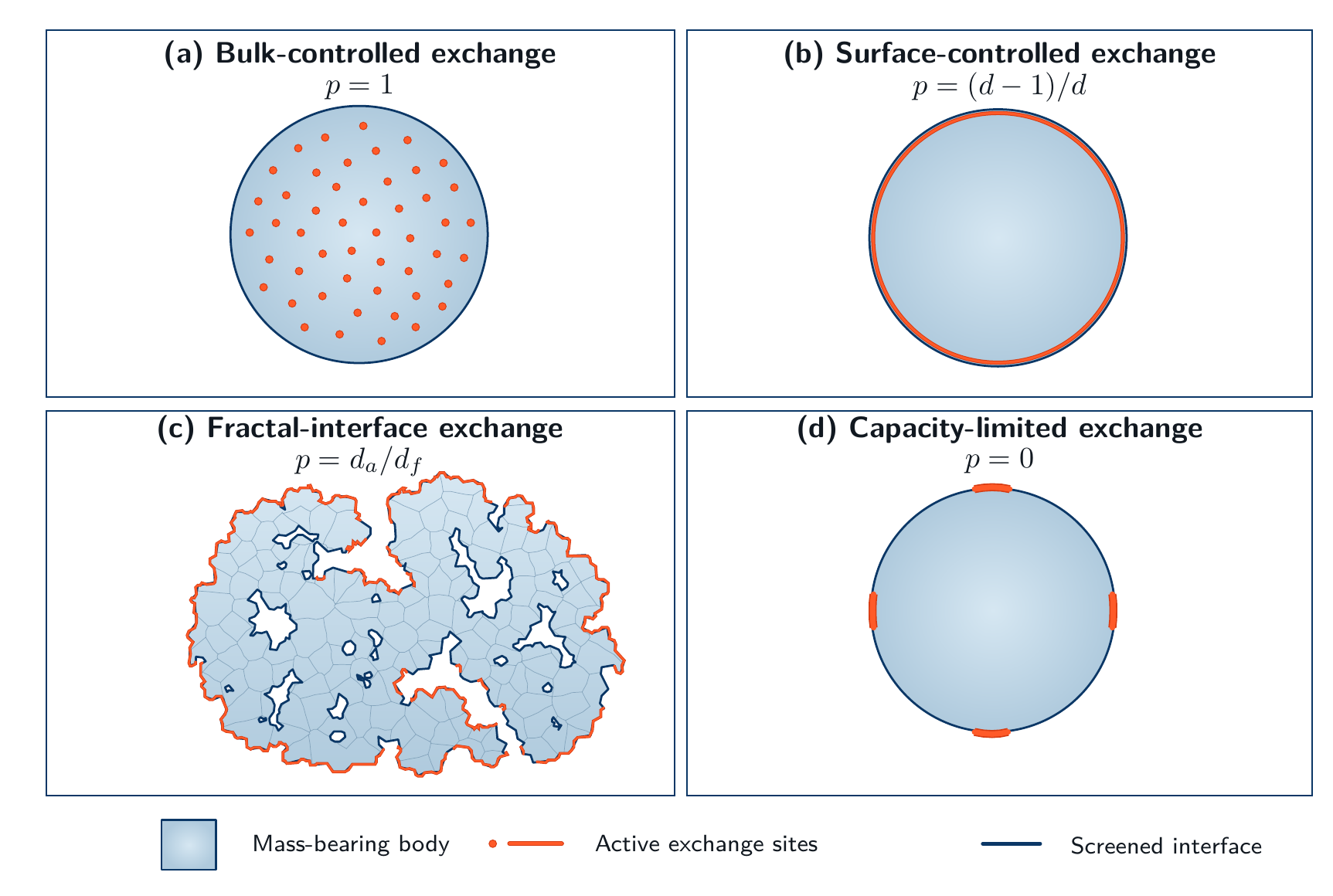
We resolve this question for exchange laws that separate the activation rate of an exchange event from its outcome. More precisely, we assume \[a(m,m_1,\alpha)=\lambda(m,m_1)g(\alpha), \qquad S=m+m_1,\] where \(g\) is a continuous symmetric probability density and \(\lambda(m,m_1)\asymp\kappa(S)\) uniformly for \(m,m_1>0\). The function \(\lambda\) measures the effective capacity of the exchange channels activated by an encounter, whereas \(g(\alpha)\,d\alpha\) is the conditional law of the outgoing share \(\alpha=m'/S\). A concrete realization of a fixed \(g\) is a mixing-dominated temporary-coalescence regime. Two droplets first form a connected liquid complex, exchange material through collision-induced internal motion, and then separate into two remnants [ATG95]. If internal mixing occurs before separation, the temporary complex may lose much of the information about the incoming partition \(m/S\). Its separation can then be only modeled in terms of the dimensionless share \(\alpha\). The comparison \(\lambda(m,m_1)\asymp\kappa(m+m_1)\) has another physical meaning. Writing \(\theta=m/S\), it requires the mass ratio to modify the total-size intensity only by a bounded factor. This property holds, for example, for the following standard collision geometries. For compact constant-density particles in \(d\) dimensions, \(m=c_\rho r^d\), and the combined-radius cross section satisfies \[(r+r_1)^{d-1} =c_\rho^{-(d-1)/d}S^{(d-1)/d} \bigl[\theta^{1/d}+(1-\theta)^{1/d}\bigr]^{d-1} \asymp S^{(d-1)/d}\] uniformly for \(0\leq\theta\leq1\) [DL25]. Likewise, if the two particles contribute additive \(p\)-homogeneous active capacities, then \[S^p\leq m^p+m_1^p\leq 2^{1-p}S^p, \qquad 0\leq p\leq1,\] while an activity attached directly to the temporary combined complex is a function of its conserved total mass \(S\) itself. We assume that \(\kappa\) satisfies the global linear bound \(\kappa(S)\lesssim1+S\) and is regularly varying at infinity with index \(p\in[0,1]\). Regular variation describes an asymptotically self-similar activity law, where the power \(S^p\) gives the leading growth while a slowly varying factor allows smaller corrections caused by shielding, porosity, or slowly changing accessibility. Experimental mass–radius laws for colloidal aggregates and calculations of accessible surface area, diffusion-controlled reaction rates, and transport to fractal aerosol aggregates show such leading power-law behavior [FZR00]. These physical laws motivate the regularly varying regimes described later in Remark 2.3.
For every Grad-cutoff hard-potential kernel \(B(E,\xi)=E^\gamma b(\xi)\), with \(0<\gamma<1\), and every nonnegative initial datum satisfying \[\int_X(1+m+m|v|^2)f_0\,dx<\infty,\] our main theorem constructs a global nonnegative integral weak solution that conserves particle number and total mass and has nonincreasing kinetic energy. More precisely, the initial mass tail is used to construct a continuous nonnegative convex function \(\Phi\), with \(\Phi(m)/m\to\infty\), and the corresponding \(\Phi\)-moment remains uniformly bounded on every finite time interval along the bounded-kernel approximations. This tail-adapted superlinear estimate prevents mass from escaping through \(m=\infty\) and allows total mass to pass to the limit. In particular, global no-gelation holds even at the additive linear scale without assuming any prescribed superlinear mass moment.
The proof begins with a convex superlinear mass weight built from dyadic hinge functions: \[\Phi(m)=m+\sum_{k\geq0}q_k(m-L_k)_+, \qquad L_k=2^kL_0.\] The coefficients \(q_k\) are chosen from the actual initial mass tail so that the initial \(\Phi\)-moment is finite, while \(\Phi\) is superlinear and the neighboring coefficients remain comparable under fixed changes of scale. Thus the construction imposes no predetermined polynomial rate of growth.
The main estimate uses the sign of the collision increment of \(\Phi\). An exact formula for each hinge function shows that collisions between sufficiently unequal incoming masses have a strictly negative \(g\)-averaged increment. Positive production at large total mass is therefore confined to comparable incoming pairs. On each finite time interval, the small-mass estimate and conservation of particle number and total mass provide a fixed bounded mass interval containing a uniformly positive number of particles. Collisions between a large particle and particles in this interval give the negative contribution used to control the positive contribution from two large comparable particles. At a dyadic scale \(L_j\), regular variation and the comparison \(\lambda(m,m_1)\asymp\kappa(m+m_1)\) bound the positive large–large increment from above by \(C\kappa(L_j)L_jq_j\), while they bound the magnitude of the negative large–bounded increment from below by \(c\kappa(L_j)L_jq_j\). This common scale cancels in the integral comparison. The hard-potential frequency comparison contributes \(L_j^\gamma\), whereas the mass bound on the population of the corresponding shell contributes \(L_j^{-1}\). Consequently, the positive large–large contribution is bounded by a constant times \(L_j^{\gamma-1}\) times the available negative large–bounded contribution. Since \(\gamma<1\), this factor tends to zero, and the large-scale production can be controlled after summation over the dyadic scales. This yields a bound for the \(\Phi\)-moment that is uniform in \(N\) and \(t\in[0,T]\), for every \(T>0\).
The limiting procedure is carried out in the space of finite Radon measures. Viewing the mass-cutoff approximate solutions as \(\mu_N(t)=f_N(t,x)\,dx\), the small-mass estimate and the physical moment bounds give tightness of the one-particle measures, while the \(\Phi\)-estimate supplies the first-moment control needed to preserve total mass. Prokhorov compactness, together with the uniform bounded-Lipschitz time estimate and the metric-valued Arzelà–Ascoli theorem, yields a global narrowly continuous measure-valued limit. Localized collision-rate estimates, together with the small- and large-mass controls, provide tightness of the collision measures. Localization to compact sets then identifies the limiting collision form and removes the mass cutoff.
Since narrow convergence alone does not exclude singular limits, absolute continuity is recovered in a separate step. Total-variation continuity places the singular parts of \(\mu_t\), on each finite time interval, on a common Lebesgue-null set and the mixed gain terms are absolutely continuous. Testing the measure equation on this set then shows that the singular particle number \(\sigma_t(X)\) is nonincreasing. It vanishes initially and hence vanishes for every \(t\geq0\). Thus \(\mu_t=f(t,x)\,dx\), and the collision measure admits a jointly measurable density in \(L^\infty(0,\infty;L^1(X))\). The measure equation consequently becomes the global \(L^1\)-valued Bochner integral equation and yields the stated \(W^{1,\infty}\)-regularity in time.
The remainder of the paper is organized as follows. Section 2 introduces the continuous-mass collision geometry, formulates the regularly varying mass-exchange assumptions and their physical interpretation, and states the main theorem. Section 3 constructs the mass-cutoff approximate solutions, establishes the uniform collision-rate and time-regularity estimates, and produces a fixed bounded mass interval containing a positive number of particles. Section 4 constructs the tail-adapted mass weight \(\Phi\), derives the signed redistribution estimate, and controls the large-comparable contribution by the large–bounded contribution. Finally, Section 5 obtains the global measure-valued limit, identifies the limiting collision measure, proves absolute continuity, and recovers the \(L^1\)-valued integral formulation.
References
Original bibliography from the manuscript · 16 references