 Siwei Luo
On the Spatially Homogeneous Boltzmann Equation with Mass Exchange
Abstract
We study the spatially homogeneous Boltzmann equation with continuous mass exchange on \(X=(0,\infty)_m\times\mathbb R^d_v\), with a Grad cut-off hard-potential collision kernel. For bounded continuous symmetric mass-exchange rates, every nonnegative initial datum with finite number, mass, and kinetic energy admits a global nonnegative \(L^1\)-integral weak solution in \(W^{1,\infty}(0,\infty;L^1(X))\) with number and mass conserved, kinetic energy dissipated. If \[\int_X (m|v|^2)^{1+\delta} f_0(x)dx<\infty,\] for some \(\delta>0\), this higher-energy moment propagates on every finite time interval and kinetic energy is conserved through the constructed solution. Moreover, every energy-dissipating solution propagates any such moment. Under the additional \(1+\gamma\) moment assumption, the solution is unique among all energy-dissipating \(L^1\)-integral weak solutions with the same initial datum. We also establish a local theory for a linearly growing mass-exchange rate. With \[H_p(f)=\int_X (1+m+m|v|^2)^pfdx,\] every datum with \(H_p(f_0)<\infty\), where \(p\ge1+\gamma\) admits a conservative local \(H_p\)-solution. Moreover, an \(H_p\)-solution continues across every finite time \(T\) for which \(H_{1+\gamma}(f)\in L^1(0,T).\) This proof requires no detailed-balance or relative-entropy structures. It is based on a new two-stage bootstrap method. The first stage rules out mass concentration at \(m=0\), while the second stage combines this control with collision geometry to establish uniform integrability. These estimates provide the compactness needed for the global solution and for the identification of the nonlinear collision form.
Introduction
Kinetic equations of Boltzmann type provide a mesoscopic description of large systems of interacting particles through binary collisions. Its mathematical theory combines the geometry of binary collisions with compactness, stability, and moment estimates for a nonlinear integral operator. Global weak and renormalized solution theories, as well as the spatially homogeneous theory for cut-off hard potentials, have been developed extensively; see, among many references, [CIP94, DL89, Vil02, MW99].
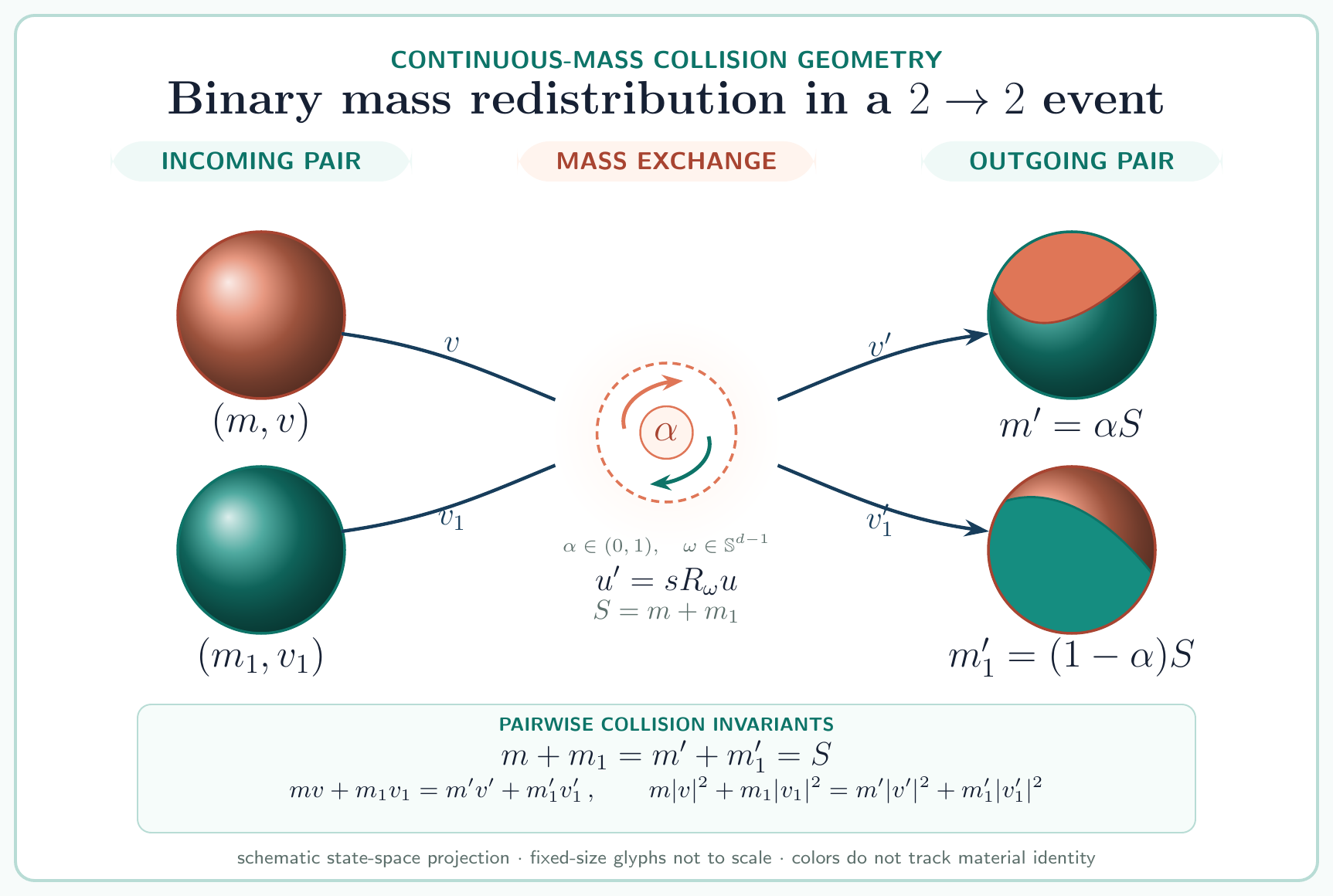
In many applications, particles carry an internal degree of freedom in addition to velocity, and collisions may exchange or redistribute that internal quantity. For polyatomic gases, this additional variable typically represents internal energy, and the corresponding collision rules redistribute translational and internal energy while preserving the total energy of each colliding pair [BDLTP94, GPČ23]. Size-structured kinetic descriptions also appear in coagulation–fragmentation theory, where particles merge or split and the number of particles generally changes [Ald99, BLL19]. At the kinetic level, continuous-mass models in which particles also carry momentum or velocity have been studied for coalescence and coagulation–fragmentation [ELM04, Bro10]. They are of type \(2\to1\) or \(1\to2\), so particle number is generally not conserved. Binary collisions with mass exchange occupy a distinct position between these settings. Each particle carries both a velocity and a physical mass and a collision redistributes the total mass between the two outgoing particles while retaining a \(2\to 2\) event structure. Thus particle number remains invariant, while the mass variable enters directly into momentum, kinetic energy, and the post-collisional velocity geometry.
The Boltzmann equation with mass exchange (BME) was introduced by Degond and Liu in a discrete-mass setting [DL25]. In that model, particle masses are integer multiples of an elementary mass, and each binary collision redistributes the combined mass of the incoming pair. Degond and Liu derived the associated conservation laws, an H-theorem, equilibrium distributions, and formal macroscopic and relaxation descriptions. The continuous-mass equation is naturally suggested by refinement of the elementary mass scale. It also defines a kinetic model in its own right, for which a direct Cauchy theory is needed.
Related continuous exchange-driven models have recently been studied in [BdCPS25, LS26]. These models describe binary redistribution of a continuous mass variable, but do not contain the velocity variable or the momentum–energy collision geometry of the BME operator. Binary exchange rules also arise in kinetic models of wealth and gambling [BT10], again with a different state space and interaction mechanism. The present work concerns specifically the Cauchy theory for the continuous mass–velocity BME collision operator.
More precisely, we study the spatially homogeneous equation on \(X=(0,\infty)_m\times\mathbb R^d_v\), with \(x=(m,v)\) and \(dx= dm dv\). The velocity collision kernel has the Grad cut-off hard-potential form \[B(E,\xi)=E^\gamma b(\xi),\qquad 0<\gamma<1,\qquad b\in L^1(\mathbb S^{d-1}).\] Here \(E\) denotes the relative kinetic energy of the incoming pair and \(\xi\) is the angular variable. We consider two regimes for the nonnegative, continuous, symmetric mass-exchange rate. In the first, \(a\) is bounded; in the second, \[a(m,m_1,\alpha)\leq A_a(1+m+m_1).\] The bounded regime admits a global theory based only on the physical moments, while the linearly growing regime leads to a local theory controlled by a higher weighted moment and a critical-moment continuation criterion.
For a nonnegative distribution \(f\), define \[M_0(f)=\int_X f dx,\qquad M_1(f)=\int_X mf dx,\qquad M_2(f)=\int_X m|v|^2fdx.\] Our first main result states that every initial datum \(f_0\ge 0\) satisfying \(M_0(f_0)+M_1(f_0)+M_2(f_0)<\infty\) generates a global nonnegative \(L^1\)-integral weak solution. The collision operator \(\mathbf Q(f,f)\) is realized as an \(L^1(X)\)-valued map, and the solution satisfies the equation as a global Bochner integral identity. Moreover, \[f\in W^{1,\infty}(0,\infty;L^1(X))\cap L^\infty(0,\infty;L^1(X;(1+m+m|v|^2)dx).\] Particle number and total mass are conserved, while the kinetic-energy inequality \[M_2(f(t))\leq M_2(f_0),\qquad t\geq0,\] holds. If \[\int_X (m|v|^2)^{1+\delta}f_0(x)dx<\infty\] for some \(\delta>0\), this higher-energy moment propagates on every compact time interval and kinetic energy is conserved. Under the additional \(1+\gamma\) moment assumption, the solution is unique among all global energy-dissipating \(L^1\)-integral weak solutions with the same initial datum.
Our second main result concerns the linearly growing regime. Define \[W(m,v)=1+m+m|v|^2, \qquad H_q(g)=\int_XW(x)^qg(x) dx.\] If \(p\geq1+\gamma\) and \(H_p(f_0)<\infty\), then there exists a nonnegative conservative local \(L^1\)-integral weak solution with locally bounded \(H_p\)-moment. Writing \(\vartheta=\gamma/(p-1)\), the truncated solutions satisfy \[\frac{d}{dt}H_p(f_n(t)) \leq C_{p,\gamma}A_a\|b\|_{L^1} H_p(f_n(t))H_{1+\gamma}(f_n(t)), \qquad H_{1+\gamma}(f_n(t)) \leq H_1(f_0)^{1-\vartheta}H_p(f_n(t))^\vartheta.\] Bihari’s inequality therefore gives an explicit positive lower bound for the lifespan. Every conservative \(H_p\)-solution satisfies \[H_p(f(t))\leq H_p(f(s)) \exp\left(C_{p,\gamma}A_a\|b\|_{L^1} \int_s^tH_{1+\gamma}(f(\tau)) d\tau\right).\] It follows that a solution extends across every finite endpoint at which \(H_{1+\gamma}(f)\) is time-integrable.
The principal issue in constructing such solutions is compactness. In the classical Boltzmann theory, entropy estimates provide an important mechanism for obtaining uniform integrability and passing to limits in nonlinear collision operators [DL89, Vil02]. For the BME entropy structure currently available, the entropy is naturally measured relative to a mass-dependent reference weight compatible with the collision transformation [DL25]. Within this relative-entropy framework, compatibility of the reference weight with mass exchange leads to detailed-balance-type relations in the mass variable. Employing this mechanism in an existence proof would therefore add structural assumptions beyond the boundedness, continuity, and natural symmetries of the collision kernels. Instead, we develop an entropy-free compactness argument based directly on the geometry of mass-exchange collisions.
Two coupled degeneracies make this problem substantially different from the usual spatially homogeneous Boltzmann equation. First, a bound on total mass does not prevent concentration of the particle-number density near \(m=0\). Second, kinetic energy controls velocity only away from the zero-mass boundary. Particles may satisfy \(m\downarrow 0\), \(|v|\uparrow\infty\) but \(m|v|^2=O(1).\) so a uniform bound on \(M_2\) does not by itself provide a uniform velocity-tail estimate. Concentration at small mass can consequently produce escape toward arbitrarily large velocities without violating the kinetic-energy bound.
The first ingredient of the proof is a new small-mass bootstrap. Let \(f_N\) be the solutions of a family of bounded-kernel approximations and set \[F_N(r,t):= \int_0^r\int_{\mathbb R^d} f_N(t,m,v) dv dm.\] By separating collisions according to whether the total incoming mass is smaller or larger than an intermediate scale \(\rho\), we derive \[\partial_t F_N(r,t)\leq CF_N(\rho,t)^{2-\gamma}+C\frac{r}{\rho},\qquad 0<r<\rho\ll 1.\] Choosing \(\rho=\sqrt{r}\) and working on sufficiently short time intervals yields a bootstrap inequality of the form \(L_I\leq C|I|L_I^{2-\gamma}\), where \(L_I=\limsup_{r\downarrow 0} \sup_N \sup_{t\in I} F_N(r,t).\) Since \(2-\gamma>1\), this enforces \(L_I=0\). Iteration over consecutive time intervals rules out concentration at \(m=0\) on every finite time interval. The same estimate resolves the degeneracy of the velocity tail.
Tightness alone does not exclude concentration on sets of small Lebesgue measure. We therefore introduce a second bootstrap for the uniform-integrability modulus \[U_N(q,t)=\sup_{\substack{A\subset X\text{ measurable}\\|A|\leq q}} \int_Af_N(t,x)dx.\] The collision space is decomposed into good and bad regions. The bad region contains the endpoints of the mass-exchange parameter, degenerate incoming mass ratios, and neighborhoods of the two resonance sets at which one of the one-particle collision Jacobians may vanish. Its contribution is controlled using the small-mass estimate, the total-mass moment, and the absolute continuity of the angular integral. On the good region, both one-particle output maps have Jacobians bounded uniformly away from zero. The area formula then bounds the gain into a small set \(A\) in terms of \(U_N(C|A|,t).\) A short-time absorption argument, followed by iteration, gives \(\lim_{q\downarrow 0}\sup_{N} \sup_{t\in [0,T]} U_N(q,t)=0\) for every \(T>0\).
Uniform integrability, tightness in mass and velocity, and time equicontinuity yield weak compactness through the Dunford–Pettis theorem [DU77]. The remaining difficulty is the identification of the quadratic collision form \(\mathcal Q_N(f_N,f_N)[\psi]\to \mathcal Q(f,f)[\psi]\). This is achieved by successively removing the kernel truncation and the high-relative-energy region, localizing the particle variables, excluding the endpoints of the mass-exchange parameter, approximating the angular kernel by continuous functions, and reducing the resulting two-particle integrands to finite sums of tensor products. The limiting collision form is subsequently represented by an \(L^1(X)\) density, which gives the global integral formulation and the stated time regularity.
The uniqueness theory requires an additional particle-energy moment. We first prove that every energy-dissipating solution propagates any initially finite moment of \((m|v|^2)^p\), \(p>1\), on compact time intervals. We then prove a weighted Kato estimate in the space associated with \(\varpi(m,v)=1+m|v|^2\). If \(f,g\) are two energy-dissipating solutions, the difference \(h=f-g\) satisfies an estimate of the form \[\frac{d}{dt}\|h(t)\|_{L^1_\varpi}\leq C\mathcal A_{f+g}(t)\|h(t)\|_{L^1_\varpi},
For classical hard-potential Boltzmann equations, Povzner-type inequalities provide instantaneous production of higher velocity moments [Pov62, Bob97, Des93, MW99, Wen97, LM12]. The mass-exchange geometry does not possess an analogous production mechanism for the individual particle-energy moments. We exhibit initial data with finite \(M_0,M_1,M_2\), but infinite \(1+\gamma\) energy moment, and construct a solution where this moment remains infinite at every finite positive time. Consequently, the moment condition entering the uniqueness theorem cannot in general be recovered dynamically from the basic existence assumptions. The remainder of the paper is organized as follows. Section 2 introduces the continuous-mass collision law, the assumptions, and the main theorem for the bounded mass-exchange kernel. Section 3 constructs the truncated bounded-collision-kernel solutions. Section 4 establishes the small-mass and uniform-integrability bootstraps, together with the mass and velocity tightness estimates, which is the most important part of the method. Section 5 proves weak compactness and identifies the nonlinear collision operator. Section 6 derives the \(L^1\)-valued formulation, the conservation laws, and higher-energy moment propagation for the constructed solution. Section 7 proves higher-energy moment propagation for arbitrary energy-dissipating solutions, establishes uniqueness in that class, and presents the obstruction to instantaneous higher-moment generation. Finally, Section 8 develops the local \(H_p\)-theory for linearly growing mass-exchange kernels and proves the critical-moment continuation and blow-up criteria.
References
Original bibliography from the manuscript · 24 references